• Oct 09 / 2026
  • Comments Off on UpTaxi or Taxi-Master: which to choose for your taxi service
UpTaxi или Такси-Мастер: что выбрать службе такси
Blog

UpTaxi or Taxi-Master: which to choose for your taxi service

Taxi-Master tops the vc.ru 2026 ranking of taxi software and is the best-known product on the market. UpTaxi is third in the same ranking. We compared both products using public data: prices, launch terms, apps, order channels and support. No marketing fluff — just numbers and the date they were taken.

Get 30 days free First-year cost

UpTaxi vs Taxi-Master in numbers

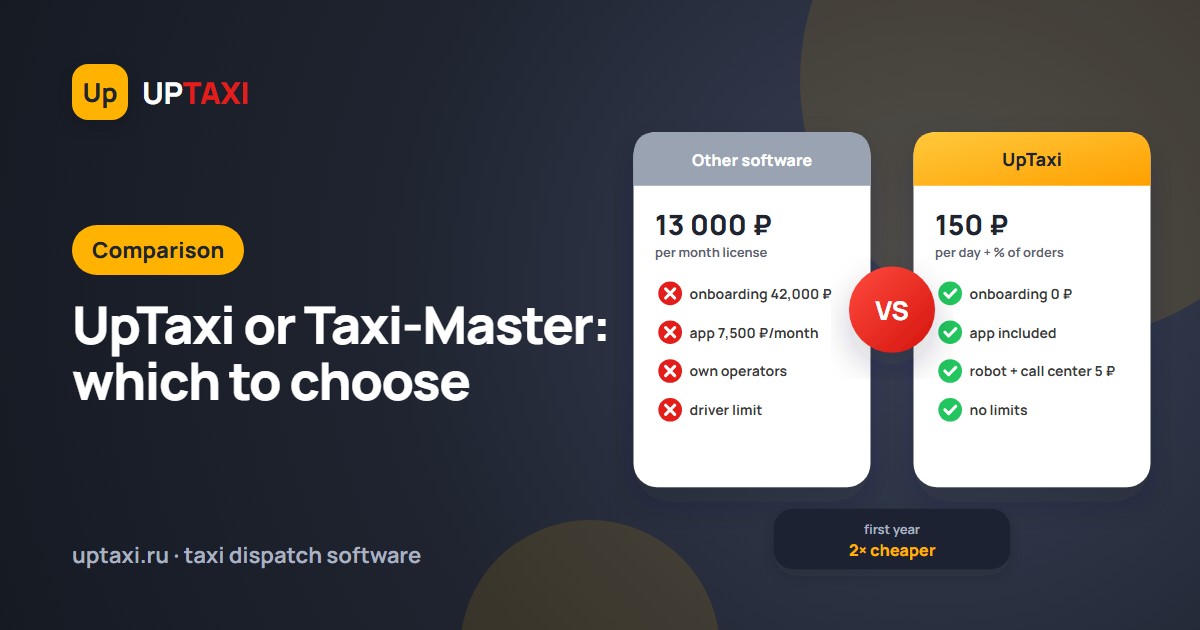
  • 2xcheaper in the first year for a 10-car service: 144,400 ₽ vs 288,000 ₽
  • 0 ₽for implementation and training. Taxi-Master charges 42,000–52,000 ₽
  • 0 ₽/monthfor the passenger app. Taxi-Master charges 7,500 ₽ a month for TaxoPhone
  • 5 ₽per order in a call center instead of your own operator staff at 160,000 ₽ a month
  • 1 dayand the server for your service is ready — no implementation specialist, no weeks of setup
  • 30 daysof full functionality in the cloud on your real orders. Taxi-Master offers a Windows demo version
  • no limiton drivers and operators. Taxi-Master has plans for 10, 35 or 120 drivers
  • 0 ₽for custom features and updates. At Taxi-Master, custom development is paid separately

Taxi-Master prices from taximaster.ru as of 9 October 2026. The detailed calculation of each number is further down the page.

In short

Taxi-Master

On the market since 2003, 4,200+ implementations in 27 countries. Rental from 13,000 ₽ a month for 10 drivers, or purchase from 260,000 ₽. Implementation 42,000–52,000 ₽, passenger app 7,500 ₽ a month. A fit for large services and networks with several brands, cargo taxi and transfers.

UpTaxi

Cloud software since 2011, 100+ services in 91 cities and 7 countries. A daily fee of 150 ₽ per day plus 7–10% of driver commissions, with no license, no implementation fee and no server of your own. The server is ready in one working day, and the first 30 days are free. A fit for small and mid-sized services, startups and those moving away from radios.

The main difference

Taxi-Master charges a fixed fee for the license and implementation regardless of how many orders the service has. UpTaxi takes a percentage of completed orders, so in quiet months the payment drops along with revenue. For a 10-car service, the first year with Taxi-Master costs about twice as much; for a 120-car service with a thousand orders a day, the software costs even out. But the main saving is not the license: in UpTaxi the voice robot is included free, and the call center costs 5 ₽ per order, so a service can work without operator staff — that is 1.9 million rubles a year for 24/7 call handling. Calculation below.

First-year cost: three services

The assumptions are the same for both products: 30 days in a month, an average fare of 250 ₽, and the service keeps 7% of the fare from the driver, i.e. 17.5 ₽ per order. For Taxi-Master we used rental with the TaxoPhone passenger app and the “Standard” implementation. For UpTaxi we added a branded app for your service on Android and iOS, 40,000 ₽ one-time, to keep the comparison fair. Taxi-Master prices from taximaster.ru as of 9 October 2026.

ServiceTaxi-Master, first yearUpTaxi, first yearDifference
10 cars, 80 orders per day288,000 ₽ (13,000 ₽ × 12 + 7,500 ₽ × 12 + implementation 42,000 ₽)144,400 ₽ (daily fee 54,000 ₽ + 10% of driver commissions 50,400 ₽ + app 40,000 ₽)UpTaxi is 143,600 ₽ cheaper
35 cars, 300 orders per day384,000 ₽ (21,000 ₽ × 12 + 7,500 ₽ × 12 + 42,000 ₽)264,100 ₽ (54,000 ₽ + 9% of driver commissions 170,100 ₽ + 40,000 ₽)UpTaxi is 119,900 ₽ cheaper
120 cars, 1,000 orders per day492,000 ₽ (30,000 ₽ × 12 + 7,500 ₽ × 12 + 42,000 ₽)481,000 ₽ (no daily fee, 7% of driver commissions 441,000 ₽ + 40,000 ₽)Almost the same

From the second year, UpTaxi’s one-time 40,000 ₽ for the app goes away, and Taxi-Master’s implementation goes away, but its technical support after the first month is paid under a separate plan not listed on the website. If the shared “UpTaxi Taxi” app works for you, subtract 40,000 ₽ from the UpTaxi calculation. You can run your own numbers in the cost calculator.

The biggest difference is operators

The license and implementation are not a taxi service’s main expense. The main one is operator salaries. To take calls 24/7 you need to cover 168 hours a week — at least four operators in shifts. At a salary of 40,000 ₽, that is 160,000 ₽ a month and 1,920,000 ₽ a year, and this amount does not depend on how many orders the service has.

In Taxi-Master, calls are taken by your own operators: there is a remote operator workspace and an “Operator School”, but the service pays the salaries. In UpTaxi, the LLM voice robot is included in the price and creates orders on its own, and if you need a live voice, calls are taken by one of eight call centers inside the system for 1 ₽ per accepted and 4 ₽ per completed order. You can skip having your own operator staff entirely.

ServiceTaxi-Master: software + own operatorsUpTaxi: software + robot + call center at 5 ₽ per orderDifference per year
10 cars, 80 orders per day288,000 ₽ + 1,920,000 ₽ = 2,208,000 ₽144,400 ₽ + 144,000 ₽ = 288,400 ₽UpTaxi is 1,919,600 ₽ cheaper
35 cars, 300 orders per day384,000 ₽ + 1,920,000 ₽ = 2,304,000 ₽264,100 ₽ + 540,000 ₽ = 804,100 ₽UpTaxi is 1,499,900 ₽ cheaper
120 cars, 1,000 orders per day492,000 ₽ + 1,920,000 ₽ = 2,412,000 ₽481,000 ₽ + 1,800,000 ₽ = 2,281,000 ₽UpTaxi is 131,000 ₽ cheaper, and the robot cuts the share of calls going to the call center even further

The operator calculation is equally approximate for both products: four positions at 40,000 ₽. For UpTaxi we took the worst case, where all orders go through the call center. In practice, the robot handles part of the calls at no charge, and orders from the app and bots need no operator at all. Plug your own numbers into the service economics calculator.

Comparison across 20 parameters

ParameterTaxi-MasterUpTaxiWhat it means for you
Pricing modelRental 13,000–30,000 ₽/month by number of drivers, or purchase 260,000–870,000 ₽150 ₽ per day and 7–10% of driver commissions; from 501 orders per day only 7%With UpTaxi, the payment rises and falls with your orders
Implementation42,000–52,000 ₽, a dedicated implementation specialistFree, server in one working dayStart with no upfront investment
TrainingIncluded in implementationFree, remote; dispatchers learn the console in 10 daysThe same, but free with UpTaxi
Trial periodDemo version to install on Windows with basic features30 days of full functionality in the cloud, free for services with 50+ orders per dayA test on real orders, not on demo data
Driver limit10, 35 or 120 on the line, depending on the rental planNo limitNo need to move to a pricier plan as you grow
Operator workstationsNo limit on rental, 2 in the “Standard” and “Business” purchase packagesNo limitThe same for rental
Passenger appTaxoPhone, 7,500 ₽/month, under the service’s brand, 48+ featuresShared “UpTaxi Taxi” app included; branded app 20,000 ₽ one-time per platformUpTaxi has no monthly fee for the app
Driver appTMDriver included, custom version 50,000 ₽“UpTaxi Driver” included, 30,000+ installs on RuStoreThe same
Driver work without an appNoDriver bot in Max: orders, statuses, chat, works without GPSOnboard drivers with any phone
Ordering via messengersNot stated on the websiteOrdering bots in Telegram and Max under the service’s brand, free broadcastsAn ordering channel with no paid SMS and no app install
Voice robotAvailable as an option, no details on the websiteLLM robot operator: understands natural speech, creates orders on its own 24/7You can drop night operator shifts
Working during mobile internet restrictionsNot statedBackup connection channel for driversThe service keeps running on restriction days
Automatic dispatchBy set rulesOn the road graph, accounting for one-way streets, own algorithm without Yandex or GoogleShorter pickups, less empty mileage
External call centerRemote operator workspace, “Operator School”8 independent call centers inside the system: 1 ₽ per accepted and 4 ₽ per completed orderYou can work with no operators of your own at all
Order sharing between servicesOrder exchange centerOrder exchange, the client stays in your databaseEssentially the same
Technical support24/7, first month free, then paid by plan24/7, included in the priceUpTaxi has no separate bill for support
Custom features and updatesRegular updates; custom development is paid, up to 3 in the “Premium” packageCustom features, updates and fixes free, requests go directly to the developersThe feature you need without a separate budget
Geography and scaleSince 2003, 4,200+ implementations, 27 countries, 120+ employeesSince 2011, 100+ services, 91 cities, 7 countriesTaxi-Master is noticeably larger
vc.ru 2026 ranking1st place, 9.6 out of 103rd place, 8.4 out of 10: fast launch, ease of use, priceBoth products are in the top three
Customer reviews on a2is.ru3.5 out of 5, 19 reviews4.8 out of 5, 17 reviewsWith a comparable number of reviews, customers rate UpTaxi higher
Related lines of businessFreight, transfers, couriers, septic services, social taxiTaxi and delivery within a taxi serviceTaxi-Master is more flexible for freight businesses

Taxi-Master data was taken from taximaster.ru on 9 October 2026 and ratings from a2is.ru on 14 October 2026; both may change. “Taxi-Master” and “TaxoPhone” are trademarks of their owner. If you spot an inaccuracy, write to us and we will fix it.

Which one fits whom

Choose Taxi-Master if

You run a network of services in several cities under different brands, you are building freight or transfers as a separate business, you are ready for implementation with a budget of 300,000 ₽+ in the first year, and you want to own the software on your own server.

Choose UpTaxi if

You have one service or several in one region, 5 to 300 cars, you are starting from scratch or moving away from radios and old software, you do not want to pay for a license and implementation, and you prefer to pay a percentage of real orders. Or you need an LLM robot, bots in Telegram and Max, and work during internet restrictions — which others do not have.

How to move from Taxi-Master to UpTaxi

We transfer the client and driver database, set up fares and districts, connect telephony and run in parallel with the old software during the switch. More on the migration from other software page. Before choosing any software, it helps to ask the developer the 12 questions from our guide.

Comparison FAQ

Why is UpTaxi third and not first?

The vc.ru ranking authors scored UpTaxi 8 out of 10 for functionality, 9 for ease of use, 8 for reliability, 8 for support and 9 for price. Taxi-Master scored higher on functionality and reliability. We show this openly and do not promise what we do not have.

Can I try both products?

Yes. The Taxi-Master demo version has to be downloaded and installed on a computer. We open UpTaxi access in the cloud for 30 days with full functionality — just submit a request.

What happens to UpTaxi’s price if orders grow?

The commission goes down as volume grows: 10% at 0–100 orders per day, 9% at 101–300, 8% at 301–500, and from 501 orders the daily fee is dropped and only 7% remains.

30 days free

Calculate it for your service

Submit a request — we will calculate the cost for your city and order volume, demo the software remotely and set up your server within a day.

Calculate cost Message on Telegram Message on Max

  • Server ready in one business day
  • No license, no server of your own
  • We reply on Telegram, Max or by phone
Request a connectionLeave your contact — we will get in touch and set up a server for your service
Request sent. We will contact you. If it is more convenient, message us on Telegram, Max or call +7 900 28-28-328.
Could not send. Call +7 900 28-28-328 or message us on Telegram or Max.
  • Oct 09 / 2026
  • Comments Off on Software for a taxi fleet with its own cars: what to consider when choosing
Программа для таксопарка со своими машинами: что нужно учесть при выборе
Blog

Software for a taxi fleet with its own cars: what to consider when choosing

A taxi fleet differs from a dispatch service in one thing: the cars belong to the fleet, not the drivers. Everything else follows from that — shifts, handing the car from one driver to the next, body condition, driver settlements, and dependence on the aggregator that sends orders. Taxi fleet software must cover these tasks, not just take calls. Below we go through what exactly to check when choosing, and show how UpTaxi handles it.

How a taxi fleet differs from a dispatch service

A dispatch service takes orders and hands them to drivers in their own cars. It needs telephony, an app and automatic dispatch. A taxi fleet also manages assets: each car must be on the line as many hours a day as possible, its condition must be monitored, and drivers change every 12 hours. If the fleet works with aggregators, there is one more task — not to be left without orders and clients when the aggregator’s terms change.

What taxi fleet software must do

Car and driver records

A car card with plate number, documents and deadlines, assigning a driver to a car, a history of who drove it and when. In UpTaxi, every driver registers through the online driver application form, goes through a document check and gets access to work only after approval. The statuses “on line”, “photo inspection” and “blocked” are visible to the dispatcher in the console.

Photo inspection without an office visit

When a car passes from shift to shift, the fleet needs to know what condition it is in. In UpTaxi, photo inspection is built into the driver app: on a schedule set by the fleet, the driver photographs the car from the required angles, a neural network on the phone checks each shot, and the dispatcher accepts the photos in the dashboard. More in the news item on vehicle photo inspection.

Driver rating and discipline

Late arrivals, refusals and client complaints should affect which orders a driver gets. In UpTaxi, the driver rating is part of automatic dispatch: all else being equal, the order goes to the driver with the better rating and the longer waiting time. The owner sees reports on each driver in the manager dashboard.

Settlements and payouts

The fleet keeps a percentage from the driver or a fixed fee per shift, and sometimes both. The software must calculate this automatically for every order, show the balance to the driver in the app and give the owner a daily summary. In UpTaxi, the balance and transfers are built into the driver app, and driver commissions are configured to the fleet’s rules.

Own order channel

A fleet that gets orders only from an aggregator does not control its revenue. The aggregator changes its commission and priorities, and the client base belongs to the aggregator. The software must give the fleet its own channels: an app under its own brand, ordering bots in Telegram and Max, a dispatch service website, and a voice robot that answers the call and creates the order without an operator. In UpTaxi, all orders from these channels go into one queue together with orders from operators.

Corporate clients

Companies that transport employees and guests pay by invoice and want to see the trips. The corporate client dashboard in UpTaxi lets employees order taxis on their own and lets the company’s manager control trips and spending. For the fleet, these are steady orders with no aggregator commission.

Reports for the owner

Revenue by day, car utilization by hour, downtime, average fare, pickup time by district. The UpTaxi manager dashboard works in a browser, including on a phone.

Cloud or your own server

A taxi fleet with its own garage sometimes feels it is natural to have its own server too. In practice, that means an administrator, backups and updates done in-house. With cloud software, the server for the fleet is ready within a working day, backups and updates are handled by the developer, and the fleet pays only for the work. In UpTaxi this is 150 ₽ per day and 7–10% of driver commissions, with no license and no implementation fee. From 501 orders per day the daily fee is dropped.

Example: a fleet of 35 cars

Thirty-five cars on two shifts make about 300 orders per day at an average fare of 250 ₽. If the fleet keeps 7% per order, that is 157,500 ₽ a month in commission income. UpTaxi will cost 4,500 ₽ in daily fees plus 9% of driver commissions, about 18,700 ₽ a month in total. You can get your own number in the service economics calculator and the cost calculator.

What else to look at

Before choosing, ask the developer the 12 questions from our guide: about limits on cars and drivers, the test period, data, support and custom development. If the fleet is moving from other software, we transfer the driver and client database during onboarding, and you can run both systems in parallel during the switch — details on the migration page.

Get 30 days free · Message on Telegram · Message on Max · Call +7 900 28-28-328

  • Oct 08 / 2026
  • Comments Off on Federal Law 580-FZ on taxis: what a taxi service owner must do to avoid fines
Закон 580-ФЗ о такси: что должен сделать владелец службы и как не получить штраф
Blog

Federal Law 580-FZ on taxis: what a taxi service owner must do to avoid fines

Federal Law No. 580-FZ “On the Organization of Passenger and Baggage Transportation by Passenger Taxi in the Russian Federation” came into force on September 1, 2023, and replaced the previous rules in effect since 2011. The main change for a taxi service owner: the ordering service became an independent market participant with its own register, obligations and liability. Previously, a “dispatch service” could formally exist as an IT intermediary. Now the law explicitly describes what it must do and what it is liable for.

This article is a brief overview of the law’s requirements as they apply to the owner of a taxi ordering service and the carriers working with it. We describe the general provisions of the federal law. Regional rules, application forms, deadlines and some requirements (for example, body color) are set by the constituent entities of the Russian Federation. The law and secondary regulations are still being refined, so before making decisions, check the current requirements with the authorized body in your region, usually the ministry or department of transport. This article is not legal advice.

Three participants and three registers

The law defines three participants in passenger taxi transportation:

  1. Carrier: the party that actually transports the passenger. This can be a legal entity, a sole proprietor, or an individual paying the professional income tax (self-employed).
  2. Passenger taxi: the car used for the transportation.
  3. Passenger taxi ordering service: the party that takes orders from passengers and passes them to carriers. This is a legal entity or a sole proprietor.

The region keeps a separate register for each participant:

Register Who is included What it gives
Register of carriers Legal entities, sole proprietors, self-employed The right to carry passengers (the equivalent of the former “permit”)
Register of passenger taxis Cars The right to use a specific car as a taxi
Register of passenger taxi ordering services Legal entities and sole proprietors The right to take and pass on orders

The registers are kept by the authorized body of the constituent entity. In many regions they are public, and any passenger or inspector can check by plate number whether a car operates legally. For an ordering service, this means checking the carrier before passing an order is not a formality but an obligation.

What a taxi ordering service must do

1. Get into the register of ordering services

To pass orders legally, the service must be included in the regional register of taxi ordering services. The application is filed with the region’s authorized body. The law provides that an ordering service must have certain technical capabilities for taking and passing orders and for interacting with the regional information system (where one has been created). Specific document requirements and the filing procedure vary by region.

If the service operates in several regions, it generally needs to be included in each region’s register. Check this.

2. Pass orders only to legal carriers

This is the key obligation. An ordering service may pass an order only to a carrier listed in the register of carriers, and only for a car included in the register of passenger taxis. Before onboarding a driver, check their status and the car’s status, then re-check regularly: register entries can be removed.

The law also makes the ordering service liable to the passenger if the order was passed to a carrier without the right to carry passengers. Check the exact wording on the nature of this liability in the current version of the law, but the point is simple: pass an order to an illegal driver, and you are liable together with them.

3. Sign contracts with carriers

The relationship between the ordering service and the carrier is formalized by a contract. This is especially important for the self-employed: an individual on the professional income tax can be included in the register of carriers only if they have a contract with a passenger taxi ordering service. In other words, the service becomes the self-employed driver’s “entry ticket” to the legal market.

4. Keep an order log

The ordering service must keep an order registration log recording details of each order: when it was taken, who it was passed to, and which car fulfilled it. The law sets a retention period for this data; check it in the current version. In practice, this means dispatch software must store the history of all orders linked to the driver and car, and let you export it on request.

5. Tell the passenger about the carrier and the car

When passing an order, the service must tell the passenger about the carrier (name or full name, register entry number), the car (make, color, plate number) and, if the passenger asks, the fare. Technically, this is done through auto-notification: a call, SMS, or a notification in the app or bot.

6. Interact with the regional information system

The law provides for regional information systems to monitor transportation. Where such a system has been created, the ordering service must send the required data to it. The data set and transfer procedure are defined by the region. If your region has not launched the system yet, follow announcements from the authorized body.

7. Give regulators access to data

The law requires giving authorized government bodies access to the ordering service’s information systems and databases in which order data is processed. The wording and procedure are in the current version of the law; ask a lawyer how this requirement applies to a service of your size.

What a carrier must do (and how the service can help)

The ordering service is not required to meet the requirements on the carrier’s behalf, but it has an interest in its drivers being legal: otherwise it cannot pass orders to them. That is why many services take on supporting drivers with these items.

Carrier requirements

  • Inclusion in the region’s register of carriers. For the self-employed, only with a contract with an ordering service.
  • Organizing pre-trip medical checks for drivers and pre-trip technical inspection of cars.
  • Issuing trip sheets.
  • Since September 1, 2024, mandatory passenger carrier insurance (OSGOP) for passenger taxis. Without a valid policy, the car should not be in the register. Check the terms and exceptions with your insurer.

Driver requirements

The law sets restrictions on who may drive a passenger taxi. The main ones include (the exact list is in the law):

  • driving experience of at least three years;
  • no unpaid administrative fines for traffic violations beyond the number set by law as of the day before the trip;
  • no license suspension or administrative arrest for certain violations within the set period;
  • no outstanding or unexpunged criminal record for certain categories of crimes;
  • passing a medical examination.

A driver on shift must carry documents confirming the trip is legal: the trip sheet, proof of inclusion in the registers and others. Check the list.

Car requirements

  • Inclusion in the region’s register of passenger taxis.
  • A color scheme (checkered pattern) on the sides of the body.
  • An orange identification light on the roof.
  • A taximeter, if the fare is calculated by time and distance. With a fixed price announced in advance, the taximeter requirement may not apply; check this.
  • Body color, if the constituent entity has set such a requirement.
  • Information displayed in the cabin: about the carrier, fares, the supervising authority; the driver’s card.
  • From 2026, requirements for localized production of cars included in the register of passenger taxis are being introduced, with transition periods and regional specifics. This is a new rule, and its application varies by region and carrier category. Be sure to check which cars can be included in the register in your region and from what date.

Dispatch software should help you meet these requirements, not get in the way: store order history, link each order to a driver and car, and automatically tell the passenger the car’s make and plate number. In UpTaxi, all of this is included in the base package. Get 30 days free.

Fines: for what and how much

Administrative liability for taxi violations is set by the Russian Code of Administrative Offenses. Amounts are revised periodically, so below are guidelines showing who is liable. Check current amounts in the effective version of the Code.

Violation Who is liable Guideline
Carrying passengers by passenger taxi without the right to do so (no register entry) Driver Fine for the driver; repeat violations may lead to stricter measures
Breach of transportation rules: no information in the cabin, no taximeter, no color scheme or roof light Driver, official, carrier Fines for drivers in the thousands of rubles, for officials in the tens of thousands, for legal entities more
Ordering service passing an order to a carrier without the right to carry passengers Ordering service (official, sole proprietor, legal entity) For legal entities, substantial amounts, up to hundreds of thousands of rubles under the current version
Failure to give the passenger information about the carrier and car Ordering service Fine for the sole proprietor or legal entity
No OSGOP policy Carrier Fine for the carrier; the car may be removed from the register
Failure to meet regional monitoring requirements (not sending data to the regional system, etc.) Ordering service Depends on the region and the version of the Code

Besides fines, the region has a more painful lever: removal from the register. An ordering service removed from the register may not pass orders, which means it cannot operate. Reinstatement takes time.

Checklist for a taxi ordering service owner

Go through the items. If your answer to any question is “I don’t know”, that is the first thing to sort out.

Legal

  • [ ] The service (legal entity or sole proprietor) is included in the regional register of taxi ordering services.
  • [ ] There is a contract with every carrier; for the self-employed, the contract on which their inclusion in the register is based.
  • [ ] Before onboarding a driver, entries in the register of carriers and the register of passenger taxis are checked; the check is repeated regularly.
  • [ ] Carriers have valid OSGOP policies.
  • [ ] It is clear who organizes pre-trip medical checks and technical inspections, and how they are documented.

Technical (software)

  • [ ] The history of all orders is stored with links to the driver and car and can be exported on request.
  • [ ] The passenger automatically receives the car’s make, color and plate number and the carrier’s details by call, SMS, in the app or bot.
  • [ ] Fares are transparent: the price is announced in advance or calculated by taximeter, and this is recorded in the order.
  • [ ] Phone calls are recorded (in case of disputes with a passenger or an inspection).
  • [ ] There are reports you can use to quickly answer a regulator’s request.
  • [ ] It is clear how to send data to the regional information system if it has been launched in your region.

Organizational

  • [ ] Drivers know which documents they must carry and how the car must be marked.
  • [ ] Someone is responsible for tracking changes to regional rules.

How dispatch software helps you comply

No software will meet the law’s requirements for you, but good software makes compliance a side effect of everyday work.

Order log. In UpTaxi, every order is saved with its date, addresses, driver, car, price and status. The manager sees this in the personal account and can export a report for any period. This is the order registration log in the sense of the law; you do not need to keep it separately.

Passenger notification. Voice and SMS auto-notification tells the customer the car’s make, color and plate number when a driver is assigned: “A blue Opel, number 323, is on its way.” The passenger sees the same in the app and in the order bot in Telegram or Max, together with the driver’s phone number. More on voice and SMS auto-notification.

Transparent price. The customer learns the price in advance based on the city’s road graph or rides by the GPS taximeter. Both options work at the same time and are recorded in the order. See price calculation.

Call recordings. Asterisk-based telephony records operators’ and drivers’ conversations with customers. If there is a dispute about what the passenger was promised, you have the recording.

Driver and car card. The software stores driver and car data; the person responsible for register compliance can conveniently keep the register entry number and check date in the card. The software does not automatically cross-check against regional registers. This is a manual procedure, and we will not claim otherwise.

Driver exchange. If an order goes to the exchange and a driver from another service fulfills it, the order data and the customer stay with your company, and the order itself is still recorded in your log. Verifying that an exchange driver is legal is the responsibility of the service they are connected to; ask a lawyer how this is formalized between services.

Self-employed drivers: what changed

Before 2023, a self-employed person could not work legally in taxi other than by renting a car from a carrier with a permit. Law 580-FZ allowed individuals on the professional income tax to obtain carrier status directly, provided they have a contract with a taxi ordering service. For a small service, this is a convenient model: a driver with their own car registers as self-employed, signs a contract with you, gets included in the register and takes orders legally.

What to keep in mind:

  • the contract with the ordering service is a condition for inclusion in the register; if the contract is terminated, carrier status may be terminated;
  • a self-employed carrier is responsible for medical checks, technical inspections, trip sheets and OSGOP; in practice, services help organize this centrally;
  • the self-employed driver’s car must also be in the register of passenger taxis and meet the requirements (checkered pattern, roof light, color if set by the region).

Common mistakes

  1. “We’re just a dispatch service; the law is about carriers.” No: an ordering service is a separate participant with its own register and its own fines.
  2. Checking a driver once at onboarding. Register entries can be removed; check regularly.
  3. Not telling the passenger the car’s details. This is a direct requirement of the law, and the easiest one to meet automatically.
  4. Keeping order history “somewhere in the software” with no way to export it. During an inspection, you will be asked to provide the log for a period.
  5. Ignoring regional rules. Body color, application forms, the regional information system: all of this is set by the region, and rules can differ between neighboring regions.

Summary

580-FZ made the taxi ordering service a full market participant with obligations: get into the register, work only with legal carriers, keep an order log, inform passengers and interact with the regional monitoring system. Most of these obligations are met automatically if your dispatch software stores history, notifies customers and provides reports.

The requirements of the law and regional regulations change; the information in this article is general. Before making decisions, check the current rules with the authorized body in your region and with a lawyer.

UpTaxi keeps the order log, automatically tells the passenger the car and driver details, records calls and gives the owner reports, all in the base package with no extra charges for modules. The first 30 days are free.

Get 30 days free · Message on Telegram · Message on Max · Call +7 900 28-28-328

Answers to frequently asked questions about the software are on the Q&A page.

  • Oct 08 / 2026
  • Comments Off on Distributed call center for taxi: stop staffing your own operators and stop losing calls
Распределённый call-центр для такси: как не держать своих операторов и не терять звонки
Blog

Distributed call center for taxi: stop staffing your own operators and stop losing calls

The biggest cost for a small taxi service is not software or telephony. It is the people who answer the phone. You need operators around the clock, including nights, weekends and holidays, while order flow is uneven: queues in the morning and evening, silence during the day and at night. So the service either overpays for idle time or loses calls at peak hours. Both cost money.

This article explains how a distributed call center works in taxi software, what it costs compared with in-house operators, who benefits from handing calls off, and who can take other services’ calls and earn from it. We also cover how an LLM voice robot takes routine calls off operators before they ever reach a person.

The problem: operators are expensive, and calls still get lost

Let’s run the numbers for a service with 100 orders a day in a city of 100–200 thousand people.

24/7 call handling in-house. You need to cover 24 hours, 7 days a week. That is 168 hours a week. With a normal 40-hour week, that is at least 4.2 full-time positions, or 5 people once you account for vacations and sick leave. At a salary of 30,000 ₽ in a small city plus payroll taxes, that is 180,000–200,000 ₽ a month. Across 3,000 orders a month, it comes to 60–65 ₽ per accepted order. For a service whose driver commission is 30–40 ₽ per order, such a call center loses money on its own.

Cutting corners at night. Many services leave one operator at night or simply forward calls to the dispatcher’s mobile phone. Quality drops, some calls go nowhere, and night orders are the most expensive ones.

Peak hours. From 7 to 9 in the morning and from 17 to 19 in the evening, a third of the day’s calls come in. If only one operator is working, the queue grows, and after 30–40 seconds of waiting customers hang up and call a competitor. To cover the peak, you have to keep a second operator all day for two hours of load.

Hence the dilemma: pay for idle time or lose calls. Classic forwarding to a third-party call center only partly solves it. An external operator does not see your software, does not know the city’s addresses and fares, and cannot assign a car. They just write down the order and pass it to you, which adds minutes and errors.

What a distributed call center is

The distributed call center in UpTaxi lets one dispatch service take and process calls for another dispatch service inside the same software. Not “forward to a phone”, but actually take the call in its own operator console: a call from your service’s customer reaches an operator at another company, who sees an order card for your city with your map, your fares and your cars. The operator creates the order, and it goes straight into automatic dispatch to your drivers.

Nothing changes for the customer: they called the familiar number, someone answered, quoted a price, and the car arrived. For you, the only change is that you do not pay an operator’s salary. You pay for results.

Inside the UpTaxi system there are 8 independent call centers competing with each other to handle calls. You choose where to route your calls and can change your choice if the quality does not suit you.

How it works technically

  • Multi-console. An operator takes calls from different cities in a single console. The software uses the number to determine which city the customer is calling from and opens the order card of the right service, with its map, addresses, fares and car statuses. The operator does not “switch between programs”. They just work.
  • Priorities and queues. A call is first offered to your own operators (if you have any), then to the connected call center. The rules are configurable: for example, only calls not answered within 15 seconds go to the queue.
  • Remote operators. An operator needs only a computer with a headset and an internet connection. They can sit in any city. This lets call centers hire where labor is cheaper.
  • Asterisk and SIP telephony. Calls go over IP telephony, so routing between dispatch services needs no hardware. Everything happens inside the software. More on telephony on the voice and SMS auto-notification page.

The mechanics are described in detail on the multi-console and call center page.

Three scenarios: fully, partly, at night

A distributed call center does not have to mean “giving up operators”. It is more often used selectively.

Scenario 1. No operators at all

Suits new services and services with up to 100–150 orders a day. The LLM voice robot holds the first line: it answers the call, asks where from and where to, clarifies details and creates the order itself. Calls the robot could not handle go to the connected call center, while the owner focuses on drivers, advertising and quality. Combined with order bots in Telegram and Max and the customer mobile app, the share of calls you pay a live operator for drops even further. All these channels are included in the base package; see order intake.

Scenario 2. Overflow only

You have one or two operators who handle most of the day. At peak hours, calls that wait in the queue longer than a set time go to the call center. You pay for the overflow and do not lose customers at peak hours, without hiring someone for two hours of load.

Scenario 3. Nights and weekends

Your own operators work during the day. From 22:00 to 7:00 and on Sundays, a 24/7 call center takes the calls. This is the most popular option among services that used to “hand the night to a mobile phone”.

All three scenarios are set up in the software and switched without involving the vendor.

What it costs

The UpTaxi rate for call handling by the distributed call center: 1 ₽ per accepted order plus 4 ₽ per completed order. So for an order the operator accepted and the driver successfully completed, you pay 5 ₽. For an order that was accepted but cancelled, 1 ₽.

Compare this with keeping your own operators for a service with 100 orders a day (3,000 a month).

Option Calculation Per month Per order
5 in-house operators, 24/7 5 × 36,000 ₽ (incl. payroll taxes) 180,000 ₽ 60 ₽
2 operators by day + night on a mobile phone 2 × 36,000 ₽ 72,000 ₽ 24 ₽ (plus night losses)
Distributed call center, all calls 3,000 × 5 ₽ (at 100% completion) 15,000 ₽ 5 ₽
2 operators by day + call center for nights and overflow (30% of calls) 72,000 + 900 × 5 76,500 ₽ 25.5 ₽

The salaries are illustrative; plug in your own. But the order of magnitude is clear: taking a call for 5 ₽ is 5–12 times cheaper than through your own operator. And when volume drops in the low season, costs fall proportionally. Payroll does not.

There is one caveat worth stating plainly. Giving up your own operators completely means you do not control who talks to your customers and how. Call centers in the system compete on quality, and you can switch, but an external operator will not reproduce the tone of “our Marina, who knows everyone by voice”. In a small city where the service runs on personal relationships, that may be a reason to keep at least one “of your own” for daytime and outsource only nights and peaks.

Run the numbers on your own data: how many orders a day, how many of them at night and at peak hours, what an operator costs in your city. Access to the software with the distributed call center is free for 30 days. Get access.

The flip side: earn with your own operators

If you run a large service with enough operators, the distributed call center turns from a cost into a source of income. You connect several small services and take their calls. Your operators get a more even workload, and you get paid for every accepted and completed order.

When this pays off most:

  • Your operators cost less than 4 ₽ per order. In regions with lower wages and in CIS countries, the cost of one accepted order in-house can be lower than what services from big cities pay. The difference is your income.
  • You have gaps in workload. During the day your operators sit without calls. Let them take other services’ calls.
  • Different time zones. If you team up with a service in another time zone, your peak hours do not overlap: when it is night for you, it is evening for them, and vice versa. Each side covers the other’s peaks, and both miss fewer calls.

This builds a market inside the system: some services buy call handling, others sell it. Neither side hands its customer base to the other. The order is created in the card of the company the customer called, and it stays there.

How this differs from plain forwarding and an external call center

Forwarding to a phone External call center under contract Distributed call center in the software
Operator sees your map, fares, cars No No Yes
Order goes straight into automatic dispatch No, must be re-entered manually No, or via integration Yes
Caller identification and order history No No Yes
Payment Call minutes Monthly flat fee or per minute of talk time Per accepted and completed order
“Nights only”, “overflow only” setup Partly Per contract In the software, on your own
Quality control No Reports Call recordings and reports in your account

The key difference is that the order is created inside your software from the first word, not retold. This removes double entry, address errors and minutes of delay.

What else reduces operator load

The distributed call center answers the question “who picks up”. At the same time, it is worth cutting the number of calls that need a human at all.

  1. LLM voice robot. This is not an IVR with “press 1” buttons. The robot answers the call, asks where from and where to, clarifies the entrance, time and preferences, understands natural speech, pauses and follow-up questions, and creates the order without an operator, around the clock. It offers a regular customer to repeat their previous address. Requests the robot cannot handle (an unusual route, a dispute) are transferred to a person, either your own or from the distributed call center. Only a handful of taxi software products have an LLM robot; most competitors have none at all, or offer a classic voice menu.
  2. Auto-notification. A call saying “a blue Opel, number 323, is on its way” and an SMS on arrival remove repeat “where is my car” calls. In services’ experience, this is one of the most common reasons for incoming calls.
  3. App and bots in Telegram and Max. Younger customers prefer not to call. The bot takes an order in three taps (geolocation or an address with suggestions, car class, and options such as a child seat) and shows statuses “driver found / car arrived / on the way” with the driver’s car make, plate number and phone. The bot is branded for the service, and sending promotions and promo codes through it is free, unlike SMS. The shared “UpTaxi Taxi” app is included in the plan; a branded app costs 20,000 ₽ per OS.
  4. Announcing queue position. If a queue does form, the customer hears “you are third in line” and hangs up less often.
  5. Automatic order intake from landline numbers. The software detects the number, recognizes the customer and fills in their details.

A service that uses all of the above usually finds that a live operator is needed only for a minority of requests: routine “home to work” orders go to the robot, bots and app. For such a service, buying handling of the remaining “live” calls from the distributed call center costs a few thousand rubles a month.

Robot and call center: how they split the flow

It helps to think of call handling as three lines:

Line Who answers What requests Cost to the service
First LLM voice robot Routine orders with clear addresses, repeat orders from regular customers Included in the plan
Second Your own operators (if any) Complex routes, corporate customers, complaints Salary
Third Distributed call center Overflow, nights, weekends, everything if you have no operators 1 ₽ + 4 ₽ per order

The better the first line works, the lower the load and costs on the second and third. The robot does not get tired, does not get sick and is just as polite at three in the morning.

How to connect: step by step

  1. Assess your call flow. In the manager’s account, look at calls by hour and the share of missed calls. This determines the scenario: everything, nights or overflow.
  2. Choose a call center. There are several call centers in the system; UpTaxi support will tell you who handles calls 24/7 and who has experience with cities of your size.
  3. Set the rules. Wait time before a call goes to the queue, the hours when calls go outside, priorities.
  4. Check the scripts. Give the call center your service’s specifics: district names, how to explain the price, what to say about arrival time.
  5. Listen to recordings. During the first week, spot-check calls; recordings are available in your account. If you are not satisfied, switch call centers.

If you want the opposite, to take other services’ calls, contact support: you will be connected to the distribution system as a call center, and calls from other services will start arriving in your console.

Summary

A distributed call center solves the old dilemma of a small taxi service: pay for idle operators or lose calls. Order intake for 1 ₽ plus 4 ₽ per completed order instead of 25–60 ₽ through an in-house operator, while the order is created in your software and goes straight to your drivers. For a large service, the same mechanism becomes extra income.

It is one of the modules included in the UpTaxi base package, along with the LLM voice robot, order bots in Telegram and Max, the customer app, road-based automatic dispatch and the driver exchange. Customers order however they like: by phone, app, website, or bot in Telegram or Max. A server for your company is set up within a day, and 24/7 support is free.

Get 30 days free · Message on Telegram · Message on Max · Call +7 900 28-28-328

The full feature list is on the about the program page.

  • Oct 08 / 2026
  • Comments Off on Automatic dispatch by roads vs. “as the crow flies”: why it determines pickup time
Автораспределение заказов по дорогам или «по прямой»: почему это решает время подачи
Blog

Automatic dispatch by roads vs. “as the crow flies”: why it determines pickup time

Pickup time is the metric customers notice first and remember longest. They compare prices with competitors once a month, but “the car took twenty minutes” sticks after the very first time, and next time they call another service. For drivers, the same metric means empty mileage: kilometers without a passenger that burn fuel and time.

For both numbers, pickup time and empty mileage, the key factor is not the number of cars on the road but how the software chooses which car gets the order. In this article, we look at two approaches to automatic dispatch, show examples where they give different results, and explain how to check what your software does.

How automatic dispatch works

When an order comes in, the software has the pickup address and the coordinates of every free car. The task is to pick the driver who will reach the customer faster than the others and offer them the order (or build a queue of offers). The dispatcher isn’t involved. They used to pick a car “by eye”, knowing the city and the drivers; now the algorithm does it in a fraction of a second.

The difference between programs is how they understand the word “nearest”.

“As the crow flies” search

The simplest method: take the coordinates of the customer and each car, calculate the distance between the points on the map as if a straight line connected them, and pick the minimum. It’s cheap to compute, needs no road map and works in any city without setup. That’s exactly why most taxi software does it.

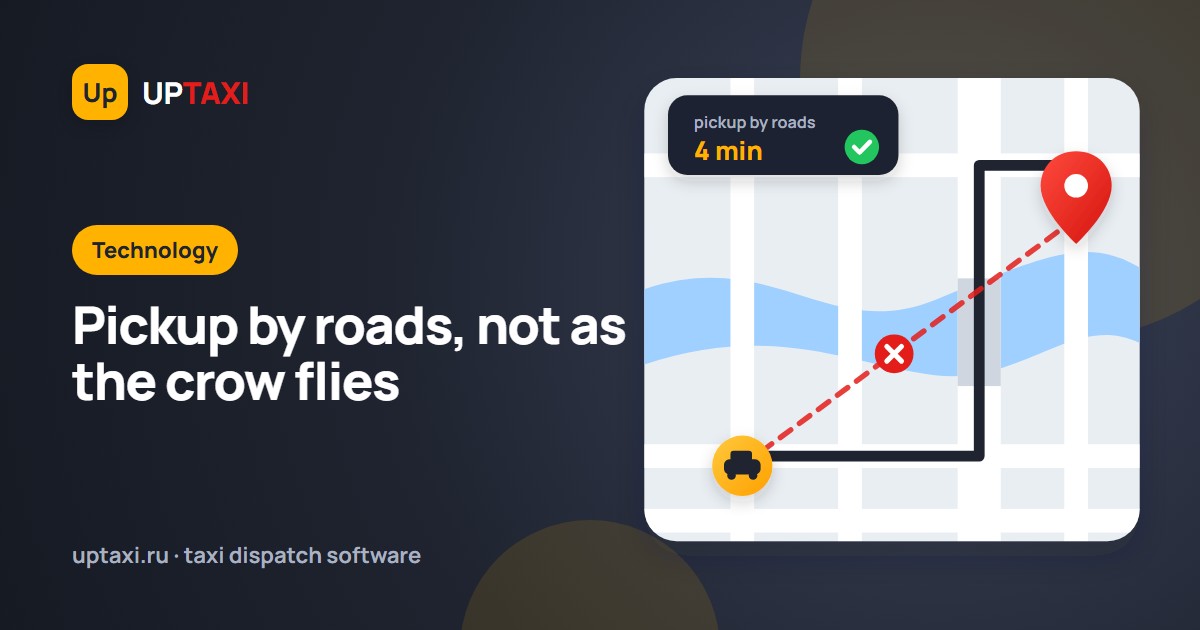
The problem is that cars don’t fly. They drive on roads, and the distance by road can be several times the distance as the crow flies.

Road graph search

The second method: represent the city as a graph, a set of intersections (nodes) and road segments between them (edges), taking into account traffic direction and banned maneuvers. For each free car, the software builds a real route to the customer and calculates its length or travel time. The nearest car is the one with the shortest route.

This is harder. You need a detailed road map of the city, you have to keep it up to date, and you need a fast algorithm that can process dozens of cars while the operator is finishing the call. But the result matches reality.

Where the two approaches diverge

In an open field with an even street grid, the difference is small. But real cities almost always have obstacles that turn “close as the crow flies” into “far by road”.

River and bridge

The customer is on one bank, the car is on the other, 300 meters away as the crow flies. But the nearest bridge is two kilometers away, and the drive to the customer is over four kilometers with a U-turn. “As the crow flies” software will give the order to this car. Another driver, 500 meters farther as the crow flies but on the same bank, would have arrived in three minutes.

Railway and industrial zone

Same story: one crossing or overpass every several kilometers. A residential area cut off from the center by a railway is typical of industrial towns. A car that looks “close” to the customer on the map may be fifteen minutes away.

One-way streets and banned turns

In the city center, a driver on the next street may have to circle the block because a left turn is banned and the street is one-way. The customer sees the car on the map two hundred meters away and waits eight minutes. Software that doesn’t know about the turn ban will pick the “wrong” driver again and again.

Median barrier

The most frustrating case: the driver is on the opposite side of an avenue with a crash barrier, and the nearest U-turn is a kilometer and a half away. As the crow flies, 30 meters. By road, three kilometers.

An example in numbers

Picture a typical situation in a city with a river. The customer is on a street by the embankment, and two cars are free.

Car A Car B
Distance as the crow flies 400 m 650 m
Distance by road 4.1 km (via the bridge) 0.9 km
Pickup time 9–11 min 2–3 min
Empty mileage 4.1 km 0.9 km

“As the crow flies” software will choose car A: the customer will wait 7 minutes longer, and the driver will drive 3 more kilometers without a passenger. Road graph software will choose car B. The difference on a single order is 7 minutes and 3 kilometers. At a hundred orders a day, even if this happens in only one case out of ten, that’s 70 minutes of customer waiting and 30 kilometers of empty mileage every day.

Why this matters especially in a small town

In a city of a million, car density is so high that a wrong choice is partly offset: there are almost always several cars near the customer, and even the “wrong” one arrives quickly. In a city of 50,000–300,000 people, there may be 20–60 cars on the road, spread across districts. Here every dispatch error is costly: there’s simply no other car nearby, and the customer waits as long as the chosen driver takes to arrive.

Small towns also share a trait: they usually have one or two “problem” zones, such as a river, a railway, a bypass with few exits, or a neighborhood with a single entrance. Every local driver knows them. A good dispatcher working with two-way radios would never send a car from the other bank. “As the crow flies” automatic dispatch loses that expertise, and a service switching from two-way radios to software sometimes notices that pickups have gotten slower. That’s not a flaw of automation as such. It’s a flaw of a specific algorithm.

How UpTaxi does it

UpTaxi finds the nearest driver using the city’s road graph, taking into account one-way streets and banned turns. It uses its own routing algorithm and its own mapping: during automatic dispatch, the software doesn’t call third-party services like Yandex or Google, so finding the nearest car is fast and doesn’t depend on the availability and limits of external APIs.

This approach has a few practical consequences.

Back-to-back order. Sometimes the driver nearest to the customer is one who is already carrying a passenger and heading to the area the new order came from. UpTaxi will offer that driver the back-to-back order: they drop off the passenger and go straight to the next one, with no empty run. For the driver, this means higher earnings per shift; for the service, less idle time.

The same graph for fare calculation. If the customer names a destination, the estimated price is calculated on the same road graph, along the shortest route with all restrictions applied. The route is shown on the map. More on the fare calculation page.

Map maintenance. The road graph needs upkeep: new interchanges, road closures, changed traffic patterns. The service handles this together with UpTaxi support: when something changes in the city, the map is corrected. That’s the honest price of accuracy: an “as the crow flies” algorithm needs no map, but it doesn’t deliver results either.

More on the mechanics on the automatic order dispatch and routing algorithm page.

Want to see how automatic dispatch by roads works on your city’s map? Get 30 days of free access; a server for your company is set up within a day. Get access.

What else affects pickup time

The nearest-car search algorithm is the foundation, but not the only factor. For consistently fast pickups, the other elements need to be set up too.

Assignment mode: list or auto-assignment

The UpTaxi driver app has two modes: the driver sees a list of orders and picks one, or the software automatically assigns the order to the nearest driver. List mode feels familiar to drivers who came from two-way radios: they “catch” orders the way they used to catch them on the air. Auto-assignment gives more even pickup times because it removes situations where a good order goes to whoever tapped first rather than whoever is closest. Many services start with the list and gradually move drivers to auto-assignment once they see that dispatch is fair.

Driver response time

This is how many seconds a driver gets to accept an order before it goes to the next one. Too few, and drivers can’t keep up and get annoyed; too many, and the order “hangs” while the customer waits. The setting is individual for each service and is usually tuned in the first weeks.

What to do when you have no cars available

If none of your drivers takes the order within the set time, the service has two options: turn the customer down or find a car elsewhere. In UpTaxi, the order automatically goes to the order exchange: a driver from another service on the same platform completes it, while the order data and the customer stay with your company, and dispatch within the exchange uses the same nearest-by-road search. For the customer, this means a car arrives instead of “all cars are busy, call back later”.

Advance orders

An order for an exact time should be assigned in advance, based on where the driver will be at that moment, not where they are now. Good software reserves a car a few minutes before pickup and doesn’t let it take a “short” order that would make it late.

Customer notifications

Even with the same pickup time, customers perceive it differently. A customer who gets an automated call saying “a white Hyundai, plate 777, is on its way, arriving in 4 minutes” waits calmly. A customer without information starts calling back after three minutes. Voice and SMS notifications take this load off operators — more.

How to check your software

If you’re not sure how your current software dispatches orders, you can check in half an hour.

  1. Ask the vendor directly. “Is the nearest driver found by distance as the crow flies or by route along the roads? Are one-way streets and banned turns taken into account?” An answer like “by GPS” or “by coordinates” usually means “as the crow flies”.
  2. Run a test at a “problem” spot. Place two test cars: one across a river or railway from the address but closer as the crow flies; the other farther as the crow flies but on the same side. Create an order and see who gets it.
  3. Look at empty mileage statistics. If the software tracks pickup mileage, compare the average distance to the customer across districts. Abnormally high values in areas near a river or railway are a sign of “as the crow flies” dispatch.
  4. Ask your drivers. They know exactly whether they sometimes get an order from the other bank while a colleague was parked right next to the customer.

What it means in money

Take a hypothetical service: 150 orders a day, 1.5 km of average empty mileage per pickup, fuel consumption of 8 L per 100 km, gasoline at 60 ₽ per liter. If automatic dispatch by roads cuts average empty mileage by just 300 meters (20%), that’s 45 km a day, 3.6 liters, about 216 ₽ a day — or 6,500 ₽ a month for the whole fleet. The amount is small, but it’s spread across drivers and feels like “you keep more with this service”.

The second effect matters much more. If slow pickups cost the service even 2% of customers a month (three orders a day out of 150), and each lost customer made an average of 4 trips a month with a driver commission of 35 ₽ per trip, then over a year the accumulated churn adds up to tens of thousands of rubles in lost driver commissions and, more importantly, lost market share that a competitor will take. The numbers are hypothetical, but the direction is right: in a small town, pickup time is the competitive advantage, because everyone’s prices are about the same.

Summary

“Nearest as the crow flies” and “nearest by road” are two different drivers in almost every city with a river, a railway, an avenue with a crash barrier or one-way streets downtown. The first approach is simpler for the developer; the second is faster for the customer and cheaper for the driver.

UpTaxi dispatches orders using a road graph that accounts for one-way streets and banned turns, with its own algorithm and its own mapping, and no calls to external services. You can check how it works on your city’s map free for 30 days.

Get 30 days free · Message on Telegram · Message on Max · Call +7 900 28-28-328

See what else the software can do on the about the program page.

  • Oct 08 / 2026
  • Comments Off on How much does taxi software cost: comparing payment models (purchase, rental, percentage of orders)
Сколько стоит программа для такси: сравнение моделей оплаты (покупка, аренда, процент с заказов)
Blog

How much does taxi software cost: comparing payment models (purchase, rental, percentage of orders)

The question “how much does taxi software cost” has no short answer. Some vendors start at 137,900 ₽ one-time, others at 5,000 ₽ a month, and others at 150 ₽ per day plus a percentage. You can’t compare these figures directly: behind them are different payment models, different sets of modules and different hidden costs.

In this article, we break down three models — license purchase, rental and a percentage of orders — calculate the real cost of ownership for services of different sizes, and show honestly where each model wins. Competitor prices are taken from their public websites at the time of writing; check current terms with the vendor before you decide.

Three payment models

License purchase

You pay once and own the software. The license is usually tied to the number of workstations or drivers, and updates and technical support after the first year are paid separately. The server is yours: either a physical one in the office or one rented from a hosting provider.

Market examples: Taxi-Master from 260,000 ₽, SKAT from 137,900 ₽, TaxiAdmin $999.

Who it suits: large services with an IT specialist on staff who want to control the infrastructure, customize the system and are ready for capital investment.

What to consider:

  • the server and its administration (VPS rental from 2,000–5,000 ₽ a month, backups, OS updates);
  • paid updates after the warranty period ends;
  • implementation: setup, training, telephony integration — with license-purchase vendors, launch usually takes weeks;
  • mobile apps are often paid for separately;
  • if the service closes or shrinks, you can’t get the money back.

Rental (subscription)

A fixed monthly fee. The server and updates are on the vendor’s side. The base price often covers a limited set of features, and add-on modules (customer app, voice robot, order exchange, analytics) cost extra.

Market examples: Taxi-Master from 13,000 ₽/month, Gutax from 10,000 ₽/month, Taxomet 6,000 ₽/month + 1.25 ₽ per order, TaxiAdmin 150 ₽ per driver per month plus a one-time 5,000 ₽ setup fee.

Who it suits: services with a stable order flow that value predictable costs.

What to consider:

  • the fixed fee doesn’t depend on whether you had orders — in the low season or at launch, that strains the economics;
  • a “per driver” fee (like TaxiAdmin’s) grows with the fleet: 50 drivers already cost 7,500 ₽ a month, 150 drivers cost 22,500 ₽;
  • modularity: the final price with the modules you need can be one and a half to two times the “starting from” price.

Percentage of orders

The vendor earns only when you earn. The fee is tied to turnover: a percentage of driver commissions or a fixed amount per order. Server, updates and support are usually included.

Market examples: UpTaxi — 150 ₽/day + 7–10% of driver commissions (the daily fee drops to zero from 501 orders a day); taxiCRM — a commission from 0.4% on payouts, but this is a payout service for aggregator fleets, not a dispatch service.

Who it suits: new services with unknown order flow; seasonal services; anyone who doesn’t want to tie up money in a license.

What to consider:

  • with high turnover, the absolute amount grows — you need to calculate where the line with rental lies;
  • cloud dependence: without internet the software is unavailable (though today this also applies to most rental solutions);
  • the percentage model requires transparent calculations — make sure you understand what base the percentage is calculated on.

What’s actually included in the price

Before comparing numbers, list what you need and check with each vendor whether it’s included. Typical “extra” items:

Feature How often it’s paid separately
Customer mobile app Often: a separate development fee or monthly
Branded app in the stores under the service’s name Almost always separate
Driver app Sometimes
Voice robot / IVR Often a separate module; an LLM robot that runs the conversation on its own is offered by very few
Ordering bots in Telegram and Max Rarely available at all; if available, often separate
SMS and voice notifications Often a separate module, plus traffic fees to the carrier
Order exchange between services Often a separate module or a percentage
Vendor-side call center Separate service
Server and its administration With a purchase, always your cost
Implementation and training With a purchase, often separate
Technical support after the first year With a purchase, often paid
Updates With a purchase, often paid

UpTaxi isn’t split into modules. The price includes all functionality: order intake through every channel (operator, an LLM voice robot operator that answers calls and creates orders on its own, ordering bots in Telegram and Max, website, app), automatic dispatch by roads, customer and driver apps, a driver bot in Max for working without installing an app, fare calculation, the order exchange, telephony with automatic notifications, a manager dashboard, loyalty programs and a ready-made dispatch service website. Only two things cost extra: a branded app in the stores (20,000 ₽ per OS, updates 7,000 ₽ per OS) and call handling by the distributed call center (1 ₽ per accepted order + 4 ₽ per completed order), if you choose to use it. The shared “UpTaxi Taxi” customer app is included.

UpTaxi pricing

Orders per day Daily fee Percentage of driver commissions
0–100 150 ₽/day 10%
101–300 150 ₽/day 9%
301–500 150 ₽/day 8%
501–1,000 0 7%
1,001+ by agreement

It’s important to understand the base: the fee is charged not on the service’s revenue or the trip price, but on the amount the service keeps from the driver. If a trip costs 250 ₽ and the service keeps a 7% driver commission, that’s 17.5 ₽, and UpTaxi’s 10% fee comes to 1.75 ₽ per order. Current terms are on the prices page.

Calculation: three services of different sizes

For a fair comparison, we use the same inputs for every option and calculate the monthly software cost (30 days). Assume an average trip of 250 ₽, a 7% driver commission (17.5 ₽ per order), and about 25 active drivers per 100 orders a day.

For a license purchase, we spread the cost over 36 months (a typical planning horizon) and add 3,000 ₽/month for server rental. For simplicity, we don’t count support and updates after the first year, although in practice they exist.

Service with 60 orders a day (launch)

Orders per month: 1,800. Driver commissions: 31,500 ₽. Drivers: about 15.

Vendor / model Calculation Total per month
UpTaxi (percentage) 150 × 30 + 10% × 31,500 7,650 ₽
Taxomet (rental) 6,000 + 1.25 × 1,800 8,250 ₽
TaxiAdmin (rental, without branded apps) 150 × 15 (+ 5,000 ₽ one-time setup) 2,250 ₽
TaxiAdmin (rental, with branded apps) 150 × 15 + 8,000 10,250 ₽
Gutax (rental) from 10,000 from 10,000 ₽
Taxi-Master (rental) from 13,000 from 13,000 ₽
SKAT (purchase) 137,900 / 36 + 3,000 ≈ 6,830 ₽
Taxi-Master (purchase) 260,000 / 36 + 3,000 ≈ 10,220 ₽

At low volume, UpTaxi is cheaper than Taxomet and Taxi-Master rental, and basic TaxiAdmin without its own apps is the cheapest on the bare number; with branded apps, TaxiAdmin already costs more than UpTaxi. But two caveats matter here. First, “from” in rental pricing means the basic package: check whether the customer app, robot, order exchange and SMS are included. Second, at 60 orders a day the service has most likely just launched, and the key question isn’t a few thousand rubles a month, but how much you have to pay before your first order. UpTaxi offers a free 30-day trial for services with 50 or more successful orders a day; otherwise, there is a non-refundable 1,000 ₽ prepayment. With a license purchase, you pay 137,900–260,000 ₽ before you know whether you have a market.

Service with 200 orders a day (established)

Orders per month: 6,000. Driver commissions: 105,000 ₽. Drivers: about 50.

Vendor / model Calculation Total per month
UpTaxi (percentage) 150 × 30 + 9% × 105,000 13,950 ₽
Taxomet (rental) 6,000 + 1.25 × 6,000 13,500 ₽
TaxiAdmin (rental, without branded apps) 150 × 50 (+ 5,000 ₽ one-time) 7,500 ₽
TaxiAdmin (rental, with branded apps) 150 × 50 + 8,000 15,500 ₽
Gutax (rental) from 10,000 from 10,000 ₽
Taxi-Master (rental) from 13,000 from 13,000 ₽
SKAT (purchase) 137,900 / 36 + 3,000 ≈ 6,830 ₽
Taxi-Master (purchase) 260,000 / 36 + 3,000 ≈ 10,220 ₽

Here UpTaxi is practically on par with Taxomet — a difference of about 450 ₽ a month — and cheaper than TaxiAdmin with branded apps. Basic TaxiAdmin without its own apps is about 6,500 ₽ a month cheaper, or about 1 ₽ per order. For that difference, the service gets full functionality with no module surcharges, 24/7 support, a voice robot, ordering bots in Telegram and Max, a driver bot in Max, no server or implementation costs, plus free enhancements, updates and fixes. If a basic dispatch service with a phone line and a driver app is enough for you, basic rental will be cheaper. If you need a customer app, a robot, an order exchange and automatic notifications, recalculate rental with modules — the gap usually disappears.

Service with 600 orders a day (large)

Orders per month: 18,000. Driver commissions: 315,000 ₽. Drivers: about 150.

Vendor / model Calculation Total per month
UpTaxi (percentage) 0 + 7% × 315,000 22,050 ₽
Taxomet (rental) 6,000 + 1.25 × 18,000 28,500 ₽
TaxiAdmin (rental, without branded apps) 150 × 150 (+ 5,000 ₽ one-time) 22,500 ₽
TaxiAdmin (rental, with branded apps) 150 × 150 + 8,000 30,500 ₽
Taxi-Master (rental) from 13,000 (more in practice with a fleet this size) from 13,000 ₽
SKAT (purchase) 137,900 / 36 + a more powerful server, ≈ 6,000 ≈ 9,830 ₽
Taxi-Master (purchase) 260,000 / 36 + server, ≈ 6,000 ≈ 13,220 ₽

For a large service, buying a license becomes the cheapest option per month — provided you have someone to administer the server and handle backups and updates, and you’re willing to pay for support separately. That’s normal economics: the bigger the turnover, the more capital investment pays off. At this volume, the percentage model is the price of not maintaining IT infrastructure and getting 24/7 support; 22,050 ₽ a month is less than one system administrator’s salary in most regions.

Want to run the numbers on your own data? Enter your order count, average fare and driver commission rate — the prices page has a calculator. Or get 30 days of access and see real numbers in the manager dashboard.

Hidden costs people forget

Server and administration. With a license purchase, this is your cost forever: VPS rental, backups, OS updates, disk replacements. If the server is in the office, add a UPS and an answer to “who fixes it at 3 a.m.?”

Implementation. Setup for your city, loading the map, fares and telephony, training operators. License-purchase vendors often charge for this separately, and launch stretches over weeks. At UpTaxi, a server for your company is ready within a day, setup is done remotely, and it’s included in the price.

Updates. Legislation changes (Federal Law 580-FZ, data requirements), app stores change publishing rules, telecom carriers change protocols. With a purchase, updates after the first year are usually paid; with rental and percentage models, they’re included.

Support. Check the hours and the cost. “Support during business hours on weekdays” for a taxi service that works nights and weekends is half the support it needs.

Apps in the stores. Publishing under your brand requires developer accounts (Google Play, App Store, RuStore), building the app and passing review. At UpTaxi, it costs 20,000 ₽ per OS one-time; with other vendors, ask — the price may be higher or lower.

Switching cost. If the software doesn’t work out, how much does it cost to leave? With a purchase, you lose the whole amount. With rental, usually nothing. With a percentage model, nothing.

How to choose a model: a short checklist

  1. Unknown order flow or fewer than 100 orders a day — a percentage of orders or cheap rental. Don’t buy a license: you don’t know whether you’ll need it.
  2. Seasonality (resort, student town) — a percentage model: you pay more in summer, less in winter, almost nothing in the off-season.
  3. A stable 200–500 orders, basic features needed — compare rental with the modules you need against the percentage model; the gap can go either way.
  4. A stable 500+ orders, an IT specialist on staff — a license purchase pays off in 1–2 years, but compare the cost of support and updates.
  5. You need every intake channel and automatic dispatch by roads — check that the vendor offers them at all before comparing prices. Not every vendor has automatic dispatch by road graph.

The honest truth about the percentage model’s weak spots

We sell our software on a percentage model and consider it the best option for small and mid-sized services. But it would be dishonest not to mention its limitations.

  • At high turnover, the absolute amount is higher than rental or a purchase spread over years. We showed this above.
  • A cloud solution means less room for deep customization than software installed on your own server. In the vc.ru 2026 ranking, UpTaxi scored 8.4 points, and the listed drawbacks were “little customization, cloud dependence, fewer integrations”. We’re working on it, but if you need a unique module built for your processes, that’s not our strength.
  • Any cloud depends on the internet. An operator workstation needs only a 1 Mbps connection, but it has to be there.

What we consider our strengths: the lowest entry threshold on the market, full functionality without modules, launch in a day, 24/7 support, automatic dispatch by roads rather than “as the crow flies”, an LLM voice robot that takes calls without an operator, and a driver bot in Max that lets drivers work without installing an app, which none of the competitors listed here offers.

Summary

No model wins for everyone. A license purchase pays off for large services with IT resources, rental for mid-sized services with basic needs, and a percentage of orders for new, seasonal and growing services that don’t want to tie up money and want everything at once.

Compare not the “starting from” price but the annual cost of ownership with the modules you need, the server, implementation, support and updates. And test before you pay: UpTaxi’s free period is 30 days, while most competitors offer 14 days or just a demo.

Get 30 days free · Calculate cost · Message on Telegram · Message on Max

Answers to common pricing questions are on the FAQ page.

  • Oct 08 / 2026
  • Comments Off on How to start a taxi service in a small town in 2026: step-by-step plan and numbers
Как открыть службу такси в небольшом городе в 2026 году: пошаговый план и расчёт
Blog

How to start a taxi service in a small town in 2026: step-by-step plan and numbers

In cities of 30,000–500,000 people, the big ride-hailing aggregators often perform poorly: few cars on the road, long pickup times, prices that spike in bad weather, and drivers who leave for whoever pays more fairly. At the same time, the “number everyone knows” is still alive in these towns: people call the local service because it answers fast and sends a car in five minutes. That is the niche where a local taxi service can make money.

This article is a practical launch plan: from choosing a legal form to your first hundred orders a day. The figures are estimates and depend on the region; plug in your own.

Step 1. Assess the local market

Before you register a business, spend a week on research. You need to understand three things: how many orders the city has, who serves them now, and where the current players are weak.

What to measure

  • Number of services and aggregators. Call each one, order a car at different times of day, time the pickup and note the price. Pay attention to how calls are answered: a live operator, a robot, a queue, “all operators are busy”.
  • Approximate market size. As a benchmark, mid-sized Russian cities see roughly a few taxi rides per resident per month, but the spread is wide: noticeably more in resort and student towns, fewer in industrial single-industry towns where many people own cars. For a city of 100,000 people, a working range is 1,000 to 3,000 orders a day for the whole market. Only your own count will be more precise: how many cars with taxi signs you see on the streets at rush hour, and how many cars competitors have by their own account.
  • Average fare. In small towns it is usually lower than in cities of a million: short trips, fixed “in-town” prices. Write down competitors’ actual prices for 3–5 typical routes.
  • Where aggregators lose. Long pickups to the outskirts, high commission for drivers, no way to book for an exact time, no corporate contracts or cashless payment for organizations, unwillingness to take intercity trips.

What to ask drivers

Talk to a dozen drivers. They will tell you more than any report. What percentage does their current service keep, how many orders do they get per shift, how fast do they get paid, do dispatchers have “favorites”, why do drivers leave. Your main resource at launch is not customers but drivers: without cars on the road, you have nothing to offer customers.

Step 2. Choose an operating model

In 2026, a local taxi service has three workable models. The choice determines both the legal structure and the economics.

Model Who carries passengers Service revenue Pros Cons
Own fleet Your cars, drivers on staff or under contract Trip revenue minus costs Full quality control Capital investment, maintenance, downtime
Dispatch service (ordering service) Licensed carrier drivers in their own cars Commission per order or a daily fee from drivers Minimal investment, fast start You must retain drivers with good service and steady order flow
Hybrid A few of your own cars plus connected drivers Mixed Your own cars fill the gaps on the road Harder accounting

For a small town with a limited startup budget, the second model usually fits best: you set up a taxi ordering service, take orders and distribute them among partner drivers. That is the model we cover below.

Step 3. Register the business and get into the registries

Since September 1, 2023, Russia has had Federal Law 580-FZ “On the Organization of Passenger and Luggage Transportation by Passenger Taxi”. It divides market participants into three groups: carriers, passenger taxis (vehicles) and taxi ordering services. The region keeps a separate registry for each group. We covered the law’s requirements in detail in a separate article, “Federal Law 580-FZ on taxis: what a service owner must do”. Here is the short version.

Legal form

  • Sole proprietorship — fits if you operate as an ordering service and don’t plan to run your own fleet. Simpler reporting, lower fines under the Code of Administrative Offenses.
  • LLC — fits if you plan to bring in partner investors, sign contracts with large organizations or run your own fleet.

The main OKVED activity code is 49.32 “Taxi operation and rental of passenger cars with driver”. An ordering service also adds 52.21 (support activities for land transportation) and 63.11 / 62.09 for the IT side. Check with your accountant which combination fits your tax regime.

Registry of taxi ordering services

To legally pass orders to carriers, the service must be included in the regional registry of ordering services. The application goes to the authorized body of the region (usually the regional ministry or department of transport). Requirements and application forms differ by region. Check the regional authority’s website or a multifunctional public services center (MFC).

Drivers and vehicles

An ordering service may pass orders only to carriers that hold a permit, and only for vehicles listed in the passenger taxi registry. Since 2023, self-employed drivers can also get a permit if they have a contract with a taxi ordering service. This is convenient for a small service: a driver with their own car registers as self-employed, signs a contract with you and gets a permit.

Help drivers through this process: prepare a contract template, step-by-step instructions for getting a permit, and a list of vehicle requirements (color scheme, roof light, a taximeter for time-based fares, regional body color requirements). A service that takes the paperwork off drivers’ hands gets loyal drivers.

If you operate in Kazakhstan, Belarus or another CIS country, the rules differ, but the logic is the same: business registration, driver and vehicle requirements, contracts with carriers. Check with your local transport authority.

Step 4. Set up order intake

Phone calls remain the main channel in small towns, but they have long stopped being the only one. Customers under 35 want to order in an app or a messenger, corporate clients via a website or under contract, and older people by phone with a live operator.

What you need for telephony

  • Multi-line city number. Short and memorable. This is your main advertising asset. Check availability with local carriers and virtual PBX providers.
  • SIP trunk or VoIP gateway. Modern taxi software works with IP telephony directly: the call goes into the software, and the operator sees the customer’s number and order history. You don’t need a separate PBX. A SIP trunk from a telecom provider is enough, or a GSM gateway if you want to take calls on a mobile number.
  • Operator workstation. A computer with 4 GB of RAM running Windows 7 64-bit or later, a headset, and wired internet of 1 Mbps or more. See the full list on the launch requirements page.

Channels without an operator

Some orders can be taken with no human involved at all. UpTaxi’s standard package includes:

  • an LLM voice robot operator — answers calls itself, asks where the customer is going from and to, clarifies details, understands natural speech and pauses, and creates the order without an operator, 24/7;
  • a taxi ordering bot in Telegram and Max — ordering in three taps: geolocation or an address with suggestions (train stations, shopping malls), choice of class and options, status updates “driver found / car has arrived / on the way” with the driver’s car make, plate number and phone; the bot can be branded for your service and used to send promotions and promo codes for free instead of SMS;
  • a ready-made dispatch service website and a customer mobile app (Android/iOS).

More on the order intake page. At launch, this lets you avoid hiring a second operator: the robot and bots handle a noticeable share of the flow, and a live person is needed only for non-standard requests.

Do you need your own operators

For a small service, round-the-clock operators are one of the heaviest cost items. An operator’s pay in a small town is roughly 25,000–40,000 ₽ a month, and 24/7 coverage takes at least 4–5 people. The alternative is to hand calls over to a distributed call center: at UpTaxi it costs 1 ₽ per accepted order plus 4 ₽ per completed order. At 100 orders a day, that is about 15,000 ₽ a month instead of the payroll of several operators. You don’t have to hand over all calls, only night calls or those stuck in the queue.

Step 5. Choose dispatch software

The software is the heart of the service: it takes the order, finds the nearest car, calculates the price, keeps the customer informed, settles accounts with drivers and gives the owner reports. It determines pickup time, and therefore whether the customer comes back.

What to look for:

  1. Payment model. Buying a license (from several hundred thousand rubles), renting (from 5,000–13,000 ₽ a month, depending on the vendor) or a percentage of orders. At launch, when order volume is unknown, the percentage model reduces risk: no orders, no costs. A comparison of models is in the article “How much does taxi software cost”.
  2. Automatic dispatch. How the software finds the nearest car: “as the crow flies” or by roads. In a town with a river, a railway or an industrial zone, that is a difference of several minutes in pickup time. UpTaxi dispatches orders using a road graph that accounts for one-way streets and banned turns — more about the algorithm.
  3. Apps and bots. A customer app (Android/iOS), a driver app, messenger bots. Drivers should be able to work without visiting the office: top up their balance and pass vehicle inspection from the app. In UpTaxi, a driver can even work without installing an app, right from the bot in Max: automatic dispatch, a feed of open orders, statuses, chat with the dispatcher, on a weak connection and even without GPS, with manual location marking. For drivers with old smartphones, this removes the main barrier to joining.
  4. Telephony and automatic notifications. Call recording, a queue, an automated call such as “a blue Opel, plate 323, is on its way to you”, an SMS when the car arrives.
  5. Order exchange. What happens to an order when your drivers don’t take it. In UpTaxi, the order goes to the order exchange, but the customer and the order data stay with your company — how it works.
  6. Launch speed and support. How many days from contract to first order, and who answers at night when something breaks.

UpTaxi sets up a server for your company within a day, configures everything remotely and gives you a 30-day free trial. You pay only from orders: from 150 ₽ per day plus a percentage of driver commissions. Get 30 days free.

Step 6. Recruit drivers

Without cars on the road, all other preparation is pointless. Gather your first 15–30 drivers before the public launch.

How to attract them

  • Transparent commission. Drivers in a small town know exactly how much competitors take. Your launch terms should be better, for example a commission-free first month.
  • Fair dispatch. Automatic dispatch by distance removes the main complaint against dispatchers: “they give the good orders to their favorites”. When the algorithm is the same for everyone, drivers appreciate it.
  • Convenience. Topping up the balance and passing vehicle inspection in the app, not at the office. An order list or auto-assignment, whichever the driver prefers. In UpTaxi, this is available in the “UpTaxi Driver” app, and for those who don’t want to install anything, in the driver bot in Max, which comes preinstalled on new smartphones in Russia.
  • Order flow. The main argument. Until you have steady flow, the order exchange helps: your driver can take orders from other services on the same platform and avoid idle time.

Where to find them

Competitors’ drivers (no aggressive poaching, just tell them your terms), local groups on social networks and messengers, ads at car repair shops and gas stations, and an in-app “refer a driver” program.

Step 7. Do the math

Below is a model for a taxi ordering service in a city of 100,000 people. All figures are estimates: plug in your own rent, salaries and advertising rates.

Startup costs

Item Estimate, ₽ Comment
Registering a sole proprietorship/LLC, bank account, stamp 1,000 – 10,000 A sole proprietorship is cheaper
Inclusion in the ordering services registry 0 – state fee Depends on the region
Multi-line number (setup) 3,000 – 30,000 A memorable number costs more
Operator workstation (PC, headset) 30,000 – 50,000 You can use an existing PC
Dispatch software 0 – 260,000+ License purchase, or 0 with a percentage model and a trial period
Branded app 0 – 40,000 UpTaxi’s shared app is included; a branded one costs 20,000 ₽ per OS
Launch advertising (outdoor, flyers, social media) 50,000 – 150,000 Key item: people must remember the number
Reserve for 2–3 months of operating costs 100,000 – 200,000 Until order flow reaches break-even
Total ≈ 200,000 – 700,000 Depending on the software payment model

The gap between the low and high end is mostly the cost of software and advertising. If you choose software paid per order, the startup budget drops by hundreds of thousands of rubles.

Monthly costs (at 100 orders a day)

Item Estimate, ₽/month
Telephony (number, SIP, minutes) 5,000 – 15,000
Operators (2 people in shifts + outsourced nights) or a distributed call center 15,000 – 80,000
Software (UpTaxi model: 150 ₽/day + 10% of driver commissions) 4,500 + percentage
Ongoing advertising 15,000 – 30,000
Accounting, communications, other 5,000 – 10,000
Total ≈ 45,000 – 140,000

Revenue

Say an average trip costs 200 ₽ and the service keeps a 15% driver commission, i.e. 30 ₽ per order. At 100 orders a day, that is 3,000 orders a month and 90,000 ₽ in driver commissions. At 300 orders a day, it is 270,000 ₽. Additional sources: daily fees from connected drivers, prepaid corporate contracts, and advertising in the app and SMS campaigns.

Break-even point

With costs of about 60,000 ₽ a month (no in-house operators, using a distributed call center) and a driver commission of 30 ₽ per order, the service breaks even at roughly 70 orders a day. With a staff of four operators, the threshold rises to 130–150 orders a day. That is why it is so important not to inflate fixed costs at launch: pay for software and call handling in proportion to orders, not as a fixed sum.

Step 8. Launch and the first 90 days

Weeks 1–2. Registration, registry application, connecting the number and SIP trunk, setting up the software (a day or two for a cloud solution), loading the city map and fares.

Weeks 3–4. Recruit your first drivers, run test orders with your own people, fine-tune automatic notifications and fares. Check how prices are calculated to the outskirts and nearby villages.

Launch day. Advertise the number: outdoor ads in high-traffic spots, flyers in mailboxes, posts in city communities, a “discount on your first ride” promotion. There is one goal: make people remember the number.

Months 1–3. Check three metrics in the manager dashboard every day: average pickup time, share of unfulfilled orders, and number of drivers on the road by hour. If pickup takes longer than 7–8 minutes, recruit more drivers or connect to the order exchange. If there are few orders at certain hours, adjust fares and advertising. Regularly call customers who ordered once and didn’t come back.

Common mistakes at launch

  1. Buying an expensive license before you have order flow. The money is tied up and the features go unused.
  2. Hiring four operators on day one. Fixed costs eat everything the first orders bring in.
  3. Saving on the phone number. Nobody remembers a number that is hard to say, and the ad budget is wasted.
  4. Launching without a city map. Inaccurate mapping means wrong price calculations and the wrong car being chosen.
  5. Neglecting drivers. They will tell passengers more about you than any banner.

The bottom line

Launching a taxi service in a small town in 2026 doesn’t require a server, a license costing hundreds of thousands, or a staff of operators. You need legal registration and a registry listing, a good phone number, a SIP trunk, a computer with a headset, 15–30 drivers, and software that dispatches orders by roads and takes orders without an operator.

UpTaxi gives you full functionality with no add-on modules. Customers order however they like: a call (the LLM robot answers on its own), the app, the website, or a bot in Telegram or Max. Drivers work from the app or directly from Max without installing anything. A server for your company is ready within a day, and support is free and available 24/7. The first 30 days are free; after that, you pay only a percentage of orders.

Get 30 days free · Message on Telegram · Message on Max · Call +7 900 28-28-328

See how other services launched on the reviews page.

  • Nov 18 / 2015
  • 1
Blog

A shoestring business. Who says that's a bad thing?

How often does a taxi driver think about starting their own taxi service? Most likely, the idea crosses the mind of most experienced cab drivers. Experience, an understanding of how the work looks from the carrier’s side and how customers behave, good knowledge of the competition in their city, ambition and the desire to earn more all play their part. In fact, you can start working for yourself right now. And you won’t need any major investment at all.
UpTaxi is software that lets you start your own business without paying for office rent, staff or equipment, and without huge advertising costs. Your first month on UpTaxi is free, and after that you are charged only for successfully completed orders, i.e. for the work actually done.
You will need to buy an advertising phone number for receiving calls from clients, with the option to make it multi-line.
For example, MultiFon from MegaFon. To get started, while order volumes are small, this option is good enough and inexpensive.
Then pass the details of your advertising number to UpTaxi technical support. The support team will configure everything needed in the software, set up the call centers, the order exchange and so on, and connect the software to your equipment. Hiring drivers. Post free ads wherever you can find in your city: newspapers, city portals, well-known free classified sites online, and so on. An interested candidate calls you. Arrange to meet at home or on neutral ground, preferably wherever is most convenient for the driver. You can inspect the car on the spot, install the driver app, show the basics of how it works and take copies of the documents. If you have a laptop or tablet with you, you can enter the new driver’s details into the software right away. After that, the driver can start working. At first you won’t have many orders of your own, but you can keep the driver busy with orders from the exchange. Pick a few low-budget ways to promote your service: posting ads on boards by apartment building entrances, dropping flyers into mailboxes, leaving business cards in public places. And that’s basically it. You have started your business. Cost: from 5,000 to 30,000 rubles. The plan above shows that you can start your own business without investment today. But that doesn’t mean you should stop there. How you develop your service further is entirely up to you. Keep improving what you have started, reinvest your earnings and don’t slack off. Remember: the first Apple computer was assembled in a garage, Euroset started out at the Luzhniki market, and I’way began its transfer service with two drivers.
  • Nov 18 / 2015
  • Comments Off on Opening a taxi dispatch service with minimal investment.
Blog

Opening a taxi dispatch service with minimal investment.

  A step-by-step guide. Taxi as a line of business is not easy. It is very specific, widespread and labor-intensive. Even so, it is the kind of business that does not require much financial investment at the start. Below we look at two ways to open your own dispatch service on UpTaxi software.
  1. Define your niche.
The taxi business can be classified by several criteria. Deciding at the very beginning who you will be over the next few years and where you are headed is very important, because it will help you work out the best development strategy, see and understand your client, identify direct and indirect competitors, and make the best offer on the market.
  1. Analyze the market.
Gather information on demand for taxi services in your city and study your competitors: their prices, their ways and methods of working, their marketing activity, and where in the city they are located. Find out what attracts drivers to a particular service, on what terms they work and, without fail, what they are unhappy about. Gathering information is not hard. Talk to friends and acquaintances, pay attention to advertising, and look up information on relevant topics online. And finally, order a taxi for yourself, then listen and watch.
  1. Register your company.
When opening a dispatch service, it makes the most sense to register as an individual entrepreneur (IP). When registering, choose and specify the types of activity that suit you. Remember that you will be providing information services, not passenger transportation services.
  1. Choose automation and buy a phone number.
Today it is hard to imagine a dispatch service or taxi service working on two-way radios. It would be like people still using pagers or sending telegrams instead of text messages alongside today’s mobile gadgets. There are plenty of offers on the market now, so you can compare them. If you don’t have a large financial cushion, cloud solutions for automating a dispatch service will suit you better. You won’t have to buy the software outright or in installments; you can simply rent it from the developer. But even then, connection terms differ from company to company, and so does functionality. UpTaxi is a hardware and software suite with extensive functionality, very affordable connection terms and a free 30-day period. Getting an advertising phone number won’t be hard. It should support multi-line connection. Prices for vanity numbers can be sky-high, but not always. In practice, telecom operators are willing to compromise: they are ready to find a suitable option or lower the price.
  1. Renting premises. Equipment. Hiring staff.
To start a dispatch service, you won’t need large premises, high-performance equipment or a lot of employees. The criteria for choosing premises are: a location within the city limits (not necessarily downtown, but not on the outskirts either, of course), easy access and parking, because drivers will come to you to get hired and to sort out issues. Since drivers may visit often, an office building with a security checkpoint, where you have to issue one-time or permanent passes, show a passport and so on, could become something of a problem for you. Equipment for launching on UpTaxi software won’t be a costly step for you either. To handle 20 calls at the same time, a computer with a 2 GHz processor, 1 GB of RAM and an 80 GB hard drive is enough. At first you can do without operators by using third-party call centers connected to UpTaxi. But if you have the opportunity and the desire to develop independently, at the initial stage you will need to hire three operators to keep your service running around the clock.
  1. Advertising and marketing.
Without advertising, a dispatch service will have an incredibly hard time. Clients need to find out about you somehow. When choosing promotion channels, recall and pay attention to what your competitors do. This is not about copying everything exactly; sometimes that is simply unaffordable. But analyzing competitor activity will help you avoid spreading yourself too thin.
  1. Financial plan.
The figures used for the calculation are averages and may vary slightly by region and city. But they give a fair overall picture.
  • Working in the cloud with a call center.
This option does not require hiring your own operators and eliminates the need to rent a large office. Strictly speaking, you can do without an office at all. Some do. But drivers are much more willing to get hired at an office. The calculation includes the rent of minimal premises. At first you will have to take on the role of the service administrator yourself. One-time costs
Item Quantity (units) Price (rubles) Total cost (rubles)
Equipment*: Computer Monitor Keyboard + mouse VoIP-GSM gateway   1 1 1 1   23,500 9,000 1,500 20,000   23,500 9,000 1,500 20,000
Furniture: Desk chairs   2 3   3,000 1,000   6,000 3,000
Software package** — 0 rubles 0
TOTAL: 63,000 rubles
* If you already have a spare computer or laptop that you can use for work, the only cost left in this item is the VoIP-GSM gateway. ** Connecting and setting up UpTaxi is free, as is the first month of work (free trial period). Recurring (monthly) costs
Item Quantity (units) Price (rubles) Total cost (rubles)
Premises rent 10 sq. m 1,000 10,000
Internet subscription 1 2,000 2,000
Phone service 1 10,000 10,000
Advertising — from 30,000 30,000
Software subscription* — from 3,000 3,000
Call center charges from 1,000 3 3,000
TOTAL: from 58,000 rubles
* Charges start only from the second month of using the software. The cost is calculated from the number of successful orders per day. So, depending on what you already have when you set up your business, your costs for opening and the first month of working in the cloud with call centers can range from 65,000 to 120,000 rubles.
  • Working in the cloud.
A more expensive option. Here you will need to hire staff from the start, which means larger premises and more equipment for workstations. One-time costs
Item Quantity (units) Price (rubles) Total cost (rubles)
Equipment: Computer Monitor Keyboard + mouse Headset VoIP-GSM gateway   3 3 3 2 1   23,500 9,000 1,500 3,000 20,000   70,500 27,000 4,500 6,000 20,000
Furniture: Desk chairs   4 5   3,000 1,000   12,000 5,000
Software package** — 0 rubles 0
TOTAL: 145,000
  Recurring (monthly) costs
Item Quantity (units) Price (rubles) Total cost (rubles)
Premises rent 10 sq. m 1,000 10,000
Salaries 3 20,000 60,000
Internet subscription 1 2,000 2,000
Phone service 1 10,000 10,000
Advertising — From 30,000 30,000
Software subscription* — From 3,000 3,000
TOTAL: From 125,000 rubles
* Charges start only from the second month of using the software. The cost is calculated from the number of successful orders per day. With this option, the costs of setting up the company and running it for the first month will start at 267,000 rubles. Don’t expect lightning-fast profits. Don’t get discouraged or give up when, in the third month of your work, you still see a loss. The fastest you can realistically get to is breaking even after 4-5 months of work. And profit will definitely come! Reaching profitability in this business takes on average from six months to a year and a half.
Telegram Max